September 24, 2014

Calibrating Regulations

This article was published in The August 2014 issue of The Gulf Magazine

Regulations and regulatory reforms are in vogue these days. The GCC has been witnessing a swathe of regulatory reforms in various sectors. How important is it to calibrate and balance reforms and regulations? This question has become hugely important in this setting.
Broadly speaking, regulations have the following characteristics:
1.     Counter-cyclical nature: We see that policy makers wake up only when there is a disaster in the making! The global financial crisis of 2008 is a great example, post which, a wave of regulations evolved that was mainly aimed at the financial sector. We hardly see regulators active when the going is good. This is actually counter intuitive. Strong regulations should be introduced when the going is good, so that the stakeholders have the energy and the time to pursue them effectively. Locking the stable after the horses have bolted away does not make good sense!

2.     Market Maturity: Regulations can be illustrated as distillations of wisdom gained from ongoing market experiments. Markets evolve over a period of time through multiple experiences and regulations are nothing but an accumulation of such experiences. The troughs and peaks as the markets waltz through time enable regulators to absorb lessons and implement relevant checks and balances as part of the continuous movement towards greater perfection.  In that sense, regulations are milestones that indicate the levels of market maturity.
  
3.     Investor Confidence: Properly introduced regulations and reforms can go much towards enhancing investor confidence. Lack of investor confidence primarily stems from a poor regulatory architecture. A case in point is the emerging and frontier markets, which in spite of its attractiveness, nevertheless suffers from poor investor confidence (especially foreign investors).

4.     Ease of Doing Business: Regulations can go a long way in easing the way business is conducted. If enacted poorly, regulations can also contribute to the opposite. It is generally considered a best practice to measure the effectiveness and success of a particular regulation based on how well it facilitates ease of doing business. Ease of doing business is generally talked about in the context of foreign investors. I feel it does apply in equal measure to local businessmen.
  
5.     Global Perception and Brand Building: Regulations can also contribute to enhanced and improved global perception about a particular market. Preservation of investor rights, intellectual property, speed of legal trials, can be cited as some examples that lead to the strengthening of a particular location or city as a brand (e.g.,Singapore). Major decisions, including setting up of manufacturing units, are critically based on the strength of global perceptions.

In the context of the aforementioned characteristics or essential features of regulations, it is worth mapping the framework to the GCC environment. The below chart illustrates the number of reforms, sector wise in the GCC, since 2008. It is interesting to note that foreign investment is an area where there have been only subdued regulatory movements; while Banking and Financial Services has witnessed intense regulatory pronouncements. There can be reasons for this. Attracting inward foreign capital may not be an immediate priority for liquidity rich GCC states. However, FDI is just not about attracting capital, only. Foreign investment can also enhance the talent pool in the region, bring new technologies, and above all, improve investor confidence and upgrade global perception. On the contrary, Banking and Financial Services is a dominant and highly mature sector contributing to over 50% of the market capitalization in the respective stock markets of the GCC countries. In the absence of an active debt market and due to a paucity of long-term funding instruments, banks end up being the primary mover of the financial wheel. This explains the “over regulated” nature of this sector.


Indicative Number of Reforms in GCC (2008-2013)
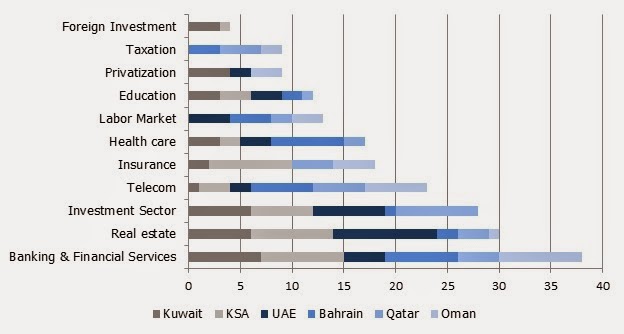
Source: Markaz Research

So, what then makes regulations effective?

1.     Balance: Under regulation may inhibit the growth of a sector; while excessive regulations may increase the cost of doing business. Hence, the need to balance regulations carefully.

      2.     Oversight: Declaring a regulation is only the opening gambit, while the real challenge lies in the implementation on the ground. A case in point are the Capital Market Authorities across many GCC countries. While CMAs’ require a spate of documentation to be submitted by the companies, they may not have the commensurate infrastructure or technology to monitor all the submissions and take action where necessary.

      3.     KPI's: Regulations become effective only when regulators don’t limit their role to just policing and fining. The agenda of regulators should be more broad based and should include the development and growth of the sectors that they are regulating. If after a decade of regulations, a sector has failed to demonstrate growth and development, then the regulators should also share the blame!

      4.     Cost: Mindless regulations should be avoided as compliance cost is an important component with respect to economic efficiency. This is particularly true of “imported regulations”, which under the name of best practices, are whisked in with little consideration given to their applicability vis-à-vis local realities.


In summary, it can be said that there can be no doubt about the integral and important role that effective regulations have. The role that they play in the organized development of a market cannot be understated or deemphasized. However, calibrating regulations and achieving a fit balance is the need of the hour.

September 03, 2014

Global Aviation: The Hare’s and the lone Tortoise!


Sometimes, figures speak more than the words. Recently I perused with interest the global aviation traffic (top 50) which revealed several insights about the gap some emerging countries like India faces in the global aviation traffic market place.

The top 50 airports in the world shared by 23 countries ferried 2.3 billion passengers accounting for 50% of the global population during 2013. USA leads the pack in terms of total passenger traffic nearly thrice the size of its population and boast of the largest network of airports to support this traffic density. Nearly 814 million people travel every year through 17 airport network within USA with Hartsfield–Jackson Atlanta International Airport being the largest ferrying around 94 million passengers followed by O'Hare International Airport with about 66 million. In terms of global ranking, Beijing Capital International Airport is now second largest after Atlanta International Airport with about 83 million passengers. However, it is the combined strength that matters more here than individual airports. At 17 airports, USA is air miles ahead of all other countries with China accounting for 7 airports in the top 50.

Dubai tops the table from a density point of view (defined as total passengers that pass through its airport relative to its population). At 66 million passengers, it transports 30 times its tiny population. Singapore Netherlands and UK also follow this hub model where there is distinct lack of connect with local population and aviation travellers though not as pronounced as Dubai.

USA is a case of domestic demand triggering the growth while countries like Australia, Spain, Malaysia and Turkey relying probably on tourist traffic to populate its air traffic density.


How about the BRIC’s? Excepting China which made inroads in the traffic density, all other countries are laggards with India being a notable one. With a population exceeding a billion, India’s total air passengers numbered only 68 million, a measly 6% of its population compared with 25% for China, 257% for USA and 3000% for Dubai. Though two airports figure in the top 50, (Delhi and Mumbai), the gap is significant and noticeable. Poor airport infrastructure, lack of focus to develop the country as a tourist destination, security concerns, affordability, poor regulations and above all economic stagnation all contribute to this sorry state of affairs. The train travel is also heavily subsidized making the conversion very difficult. While the noise made by low cost airlines and the associated price wars is interesting and may give an impression that Indian aviation is probably full of activity, statistics show that we have raced to the bottom over time and have a huge catch up to do. While in this race of global aviation traffic, there are several hare’s (USA, China, Dubai, etc.), there is only one tortoise!


August 18, 2014

Modi and NRI’s

This article was published in Indians in Kuwait website

The euphoria has settled and Narendra Modi is now our Prime Minister. What does that mean for NRI’s in the Gulf and more specifically in Kuwait.

The Indian diaspora in Kuwait (and the wider Gulf) is undergoing significant transformation from economic and social perspective. During the past few years they have had to encounter several challenges in the areas of education, investments, jobs and more importantly currency fluctuations. All these factors tend to affect NRI mindset. Now that a new leadership is in place in India, it will be interesting to see how this leadership transformation in India will affect NRI’s. I see the following implications:

      1.       Jobs
It is important to note that we have witnessed some sluggishness in the GCC in terms of job opportunities and more so in Kuwait where the exodus of people rendered jobless increased during recent years forcing them to return to their motherland.  Project uptake has been slow in Kuwait and hence fewer needs for even low skilled labors leave alone high skilled technocrats. Kuwait companies have been restructuring and downsizing and hence finding opportunities for displaced people is becoming that much more difficult. How will this situation change given the new leadership in India? It may not change the situation here in Kuwait, but it may change the situation back home in terms of job opportunities. The main deficit India has been facing is that of confidence. Narendra Modi will try and infuse that among business leaders who will then not hesitate to invest in new projects leading to more opportunities back home. Also, the clear mandate given to him by the people of India means that he can take painful decisions without fear or favor. This is required to restart the Indian economy and put it on track at the quickest pace.

      2.       Rupee
The currency performance during the past few years has been of great interest to NRI’s. Steady depreciation of rupee vis-à-vis other currencies (especially USD) has given some cheer to the diaspora as they can now remit more for the same Dinar. However, a strong Indian economy in the medium to long-term will also mean a strong rupee which may not make NRI’s all that happy. Expect Rupee to steadily appreciate over the next few years.

     3.       Stock Market
Many NRI’s have invested in Indian stock market either through mutual funds or directly themselves. Apart from real estate and fixed deposits, stock market investing is a key element of investment for NRI’s. However, over the last few years Indian stock market did not perform as well as say the American stock market. The average annual return is about 11% during the last three years. Corporates listed in the stock market are finding it hard to report healthy growth in earnings, debt level in the balance sheet has increased over time, and slowing economy has not resulted in increased demand leading to lower margins and profitability. All this is bound to reverse once economy is put back on growth track, and liquidity being made available to sectors like Real estate and infrastructure for uplifting projects. Foreign investors have already factored in a grand performance of stock market in the coming years. Investments even at the current level may make immense sense for NRI’s especially in blue chip companies for the medium and long-term though stock markets always encounters volatility in the short term.

      4.       Real Estate
NRI’s have significant real estate commitments back home. Property market has not been doing all that great especially in metros and other important cities. Though prices have not come down drastically, the number of transactions have dwindled taking away liquidity. Major projects are either on hold or getting unreasonably delayed while people borrowed to invest in them. Real estate is a very important element of investing for NRI’s and hence the new leadership is very important for this. The key limitation of the real estate market is the lack of bank funding as banks have either reached their limits or are wary about the non-performing loans to this segment. Also, the dull performance of the IT sector means a significant slowdown in demand. Modi government is expected to provide some directions to institutions and enable reenergizing demand in this vital segment.

      5.       Education
The higher education market in India is especially of interest to NRI’s who invariably decide to send their wards either to India for Bachelor’s degree or to the West if they can afford. However, options back home are quite limited due to skewed demand supply factor where demand far exceeds that of supply for leading institutions leading many NRI’s to fork out extra money (under NRI quota) to get their wards admitted. A simple solution to this problem is to establish more institutions of higher learning. Modi has already made right noises in this direction by espousing “IIT’s and IIM’s in every state in India”. If this dream comes true, then NRI’s can revel in delight and need not worry about the expensive western education for their wards.

      6.       Pride
After all, we are first Indian citizens and then NRI’s. We will all feel immensely proud to belong to a nation that is vibrant, growing and becoming influential in the global market place. We don’t want a weak and non-performing India. Having a leader who can transform a weak India into a super power is what we want to see as Indians and NRI’s. Narendra Modi government should work itself towards this avowed objective and make us proud.


Jai Hind!

August 04, 2014

Corporate Lessons from a Comedian!

This article was published in Indians in Kuwait website
Sometimes comedians can make serious sense! The other day I was watching an interview with Vadivelu by Divyadarshini (popularly known as DD) in the famous Koffee with DD show in Star Vijay. Vadivelu is a legendry comedian in Tamil movie industry and is an institution by himself for the space he has carved out with audience through his unique wit and humour.
While the intention was to get entertained by Vadivelu through his humorous response, I was suddenly stuck by something that he said in the middle. When queried on what are the three things that he learnt in his 25 years of acting in Tollywood, he responded as follows:

1.       I learnt my acting while in the industry

2.       Never trust what people say in front of you

3.       You can sustain only so long as you produce successes. You are out once you fail
Let us run through this in the corporate world and see how much it resonates.

Lesson 1: Learn while you earn
The corporate world expects you to have sufficient qualification and experience before being trusted with a position. It expects you to come totally prepared so that you can fire from day one. Hence this clamour for credentials from superior institutions (IIT’s and IIM’s) and the craving to have star names in your CV. The corporate world perceives the function to be a job and a process to be driven smoothly. If only it is wired along the lines of the movie industry where it is tolerant for someone like Vadivelu to learn while on the job , it could have produced many more leaders today.

Lesson 2: Never trust what people say in front of you
Vadivelu opines that it is nearly impossible to decipher the true intentions when people say something to you. In other words, they may shower laurels and praises about all your past achievements just to appease your ego, while on the back they may shamelessly bitch you according to him. The challenge lies in detecting that and find your winning ways. While this applies to most fields in our lives, it is particularly evident in the corporate world especially as you climb higher in hierarchy. However, the intensity of such false allurements may be less in the corporate world especially in surroundings where professionals are engaged. The need to be ethical may force few to be upright in terms of feedback and may not resort to “back biting”. But that would be a minority I suppose.

Lesson 3:  You can sustain only so long as you produce successes. You are out once you fail
In other words, only performance and performance alone matters. Legacy cannot support you even one bit. I see this apply in several other fields like sports, medicine, etc other than government bureaucracy! In such a scenario, learning from failures becomes equally if not more important than to clock success.

June 01, 2014

ASSESSING FUND MANAGER: THE 4D APPROACH


This article was published in The June 2014 issue of the Global Analyst

Mutual fund investors generally prefer a fund due to its historical performance. In the context of an equity fund, the primary expectation is that the fund manager should outperform his stated benchmark. For eg., if his benchmark is that of Nifty 50 or Sensex, the fund’s performance should be better than the benchmark to justify investor confidence in the fund. The extent to which the manager outperforms the benchmark is the second important element of attraction.
In an attempt to beat the benchmark, the fund manager is always in pursuit of winners and tactful in avoiding losers while selecting stocks. Where the winners outnumber the losers and where the fund manager’s commitment to winners (in terms of allocation) is better than the losers, he or she will generate out performance or what is technically called as alpha (excess performance over the benchmark). In other words, where a fund manager generates superior performance through consistently beating the benchmark, he/she is good at picking winners and avoiding losers. While this assessment sounds simplistic and hence reasonable, more often than not this 2 dimensional approach to assessing fund manager performance may not be enough.

In my view, the issue of fund management in the context of equity revolves around the concept of bets. There are bets that the fund manager sticks with and there are bets that he avoids. Hence, we need to view the issue from a 4-D perspective:


Dimension 1: Persistent Bets: These are bets that the fund manager is sticking with resolutely and believes in them strongly. A simple way to figure this out is to see if a particular stock is present at the beginning as well as  end of an evaluation period. The reason why he persists with these stocks can be borne out of a thorough research and fund managers’ conviction about its future ability to perform. If the stock price of persistent bets move up, the manager gains and vice-versa.
Dimension 2: Discarded Bets: These are bets that the fund manager has lost faith in and therefore sold out. A way to find this out is to see if a particular stock figures in the beginning portfolio but not in the end period portfolio. In this scenario, if the stock price gains after the manager has discarded them, the manager tends to lose out on performance.
Dimension 3: Missed Bets: These are bets that the manager did not take or we can call it as “failed to buy” scenario. These bets will not figure either in the beginning portfolio or end portfolio. In such cases, where the stock price moves up, the manager loses out in terms of opportunity gain and vice-versa.
Dimension 4: New Bets: These are bets that the manager took recently. A simple way to figure them out is when such stocks are present in the end period portfolio and not in the beginning period portfolio. Like persistent bets, the manager gains when such stocks move up and vice-versa.

Case Study: HDFC Top 200 Fund
Let us run through this 4D concept through the evaluation of the performance of HDFC Top 200 fund, one of the most popular equity funds in India.

Fund Return-2013
4.05%
Benchmark, BSE 200 Return-2013
4.38%
Alpha
-0.33%


As we can see, the fund has underperformed the benchmark albeit slightly during 2013. However, dissecting this further, we can perform a 4-D analysis on this.

Dimension 1: Persistent Bets:

Persistent Bets-Top10
Performance-2013
Weights (Average)
ICICI Bank Ltd.
-3%
7%
Infosys Ltd.
50%
7%
State Bank of India
-26%
7%
ITC Ltd.
12%
5%
Tata Motors Ltd.
20%
4%
Larsen & Toubro Ltd.
0%
4%
Reliance Industries Ltd.
7%
4%
HDFC Bank Ltd.
-2%
3%
Tata Consultancy Services Ltd.
72%
3%
Bank of Baroda
-26%
3%

The manager persisted with 55 stocks in his portfolio that figured both in the beginning and end portfolios. The above table provides the list of top 10 arranged in terms of weight. As we can see, most of these persistent bets are large cap blue chip heavy weights and are reputable names in the Indian stock market. Excepting for a few like ICICI Bank, SBI, HDFC Bank and Bank of Baroda (all bank stocks incidentally!), all others have done well especially TCS and Infosys (IT stocks incidentally!). The weighted average performance of persistent bets is 6.71% which is commendable.

Dimension 2: Discarded Bets:
Discarded Bets
Performance-2013
Weights (Beginning)
Hindustan Unilever Ltd.
9%
1.7%
LIC Housing Finance Ltd.
-25%
1.2%
Sun Pharmaceuticals Industries Ltd.
54%
0.9%
Tata Power Co. Ltd.
-17%
0.8%
Titan Industries Ltd.
-19%
0.7%
Cairn India Ltd.
2%
0.6%
Mahindra & Mahindra Ltd.
1%
0.5%
CMC Ltd.
36%
0.5%
NHPC Ltd.
-23%
0.4%
Britannia Industries Ltd.
84%
0.3%

During the year, the fund manager sold out (or discarded) 19 stocks while the table presents the top 10 in terms of weights. In some cases, the fund manager was right as in the case of LIC Housing finance, Tata Power, Titan, etc. But in many cases the fund manager paid a penalty of discarding some stocks whose performance later turned out to be very good. Good examples include Hindustan Lever, Sun Pharma, CMC and Britannia. The weighted performance of discarded bets is 0.49%. In other words, had he not discarded them, he would have added 0.49% to the portfolio performance.

Dimension 3: Missed Bets:
Missed Bets
Performance 2013
Weights (Index)
HCL Tech
104%
2%
NTPC
-13%
1%
Kotak Mahindra
12%
1%
Ultratech
-11%
1%
Hindustan Zinc
-3%
1%
Asian Paints
11%
1%
Adani Enterprises
-3%
1%
Nestle
6%
1%
Bhel
-23%
1%
Hero Motors
9%
1%

Here is a list of stocks that the fund manager did not look at all and in this case it runs into 125 stocks. However, a perusal of the top 10 among them in terms of weights reveal some interesting stuff. The greatest miss has been HCL Tech that performed more than 100% during 2013. Given the names like TCS and Infosys in the persistent bets list, it is surprising to see HCL Tech missing. The list of missed bets is a mixed bag with many posting negative performance ( NTPC, Ultratech, BHEL, etc). The weighted performance of this list is 2.55% which is quite significant. In other words, had he pursued these bets, the portfolio performance would be better by 2.55%.

Dimension 4: New Bets:
New Bets
Performance-2013
Weights (End)
Sesa Sterlite Ltd.
3%
2%
Idea Cellular Ltd
61%
0.3%
Siemens Ltd.
0%
0.3%
Jaiprakash Power Ventures Ltd.
-50%
0.2%
Alstom T&D India Ltd.
-9%
0.2%
Jet Airways (India) Ltd.
-48%
0.1%

This list is the smallest comprising in all 6 stocks. The biggest new bet is that of Sesa Sterlite that performed just 3% while block buster performance of 61% of Idea Cellular did not benefit much due to low weight. Similarly disastrous performance of stocks like Jaiprakash Power and Jet Airways did not hurt much due to lower weights. The total weighted performance of new bets is 0.09%.
In summary, we can tabulate thus:
Category
Weighted Returns
Persistent bets
6.71%
Missed bets
2.55%
Discarded bets
0.49%
New bets
0.09%

While the portfolio benefited hugely through the persistent bets, it also suffered due to missed bets while the impact of discarded bets and new bets has not been pronounced.
Caveat: In hindsight things always look very clear. Secondly, this analysis was performed taking into account the portfolio composition at the beginning and end of the evaluation period (2013). The performance of a portfolio is also affected by several transactions that happens in the intervening period and hence may cloud the analysis.
Having highlighted the caveats, the idea of this research is to take the literature of fund manager performance one step higher by looking at the opportunity cost of missing something and also the opportunity cost of sticking with bad choices which can take a heavy toll on the portfolio performance. What makes a fund manager stick with a bet, discard a bet, miss a bet or take a new bet is a combination of several factors including his ability to pick stocks, ability not to get distracted by peer group pressure, ability to have sound advice and being vigilant. In the end, the aim of any active fund manager is to generate alpha which is the only reason why investors are ready to pay management fees. In the absence of such a proposition, an Exchange traded fund (ETF) can simply do the job. In an ETF scenario, there is only one bet i.e, Index composition!.

The author thanks Karthik Ramesh and Rajesh Dheenathayalan for their assistance