Showing posts with label Regulatory. Show all posts

October 29, 2014

New Institutions and Legislations in Kuwait

This article was published in The October 2014 issue of The Gulf

Over the past three years, Kuwait has witnessed a raft of new regulations and legislations aimed at making doing business in the country easier and transparent. Some of the recent key legislations are recorded in the table below –
Year
Legislative Authority
Brief Commentary
2010
Kuwaiti Parliament
Privatization law passed

2010
Kuwaiti Government
Labor Law for the private sector that details the procedures to be followed along the full employment spectrum, right from recruitment to separation

2010
Central Bank of Kuwait (CBK)
A set of regulations was passed, in an effort to increase transparency, accountability and overall health of the investment sector

2010
Kuwaiti Parliament
Kuwait Capital Markets Authority (CMA) comes into being

2012
CBK
CBK issued new guidelines on governance at banks in Kuwait

2012
Kuwaiti Government
Companies Law passed in order to make doing business in Kuwait more attractive

2013
Kuwaiti Parliament
A law was approved to establish a SMEs fund, with a capital of KD2 billion (~$7 billion)

2013
CMA
Passed a resolution on corporate governance rules applicable for listed companies

2013
Kuwaiti Government
Anti-Corruption Authority (ACA) established to tackle corruption in the handling of public funds

2013
Kuwaiti Government
A new commercial licenses law completed that would reduce the bureaucracy surrounding new businesses

2013
Kuwaiti Government
The maximum amount of home loans available to Kuwaiti women, increased, to KWD 70,000 from KWD 45,000, while the renovation amount that can be financed, has been increased to KWD 35,000 from KWD 30,000

2013
Kuwaiti Government
Law No. 116 released promising a raft of FDI benefits, including 100% equity ownership, 100% tax exemption for 10 years, partial/full tax exemption on imports (raw materials, machinery & spare parts), land being made available etc. The law was passed in order to promote FDI in Kuwait.

2013
Kuwaiti Government
Kuwait Direct Investment Promotion
Authority (KDIPA) set up, as an enhanced successor of Kuwait Foreign Investment Bureau (KFIB), for promotion of direct investment into Kuwait

2014
The National Assembly
A new Public Private Partnership (PPP) law that is essentially a modification of the 2008 Build-Operate-Transfer (BOT) passed

2014
CBK
Foreign banks allowed to open multiple branches in Kuwait

2014
CBK
Regulations issued regarding Basel III Capital Adequacy Standard for banks


A scan of the above list will tell us that the focus of Kuwait has been to improve business governance within the country and strengthen regulations and laws that would boost investor confidence. The 2009-2014 five year development plan of Kuwait has seen only limited success, at best, with many of the projects being transferred to the new five year plan of 2015-2020[1]. However, despite the push ahead with multiple legislations and new bodies, there is evidence that implementing change will not be easy. Media reports indicate that the CMA is facing lot of pushback against its efforts to encourage corporate information disclosure and in enforcing rules against excessively speculative trading[2]. There has been opposition to some of CMA policies that is causing delay in implementation. For instance, the reforms deadline on the corporate governance agenda has been pushed to June 2016[3].
The case of Kuwait Airways is considered a good example of difficulties of privatization in Kuwait. The Airline has been making losses for quite some time and is taking steps such as retrenchment in order to cut down costs[4]. Yet, privatization plans to modernize the airline and make it a more profitable venture has elicited resistance from various stakeholders, including company personnel and law makers[5]. Privatization is expected to be a matter that would require great acumen and strategic thinking in order to facilitate effective implementation across various projects in the country. Closely linked to the theme of privatization is the deeply felt need to making Kuwait a great place to do business, so that it can effectively challenge regional and global leaders. In that regard, the relatively new companies and licenses law are a great boost. However, these institutions will need to be tied with larger reforms in education and infrastructure in order for foreign companies and entities to feel enticed in order to benefit from the tremendous business advantages that Kuwait offers.
On the FDI front, the independent public authority, KDIPA, has complete control over its own budget and recruitment process[6]. Kuwait’s Ministry of Finance presides over KDIPA, which among other factors, is expected to streamline the process of decision making on FDI applications. There is already some indication of this. In September 2014, Kuwait suspended its offset obligations programme that compels foreign contractors, who win sizeable government contracts in Kuwait, to invest in some prescribed fashion in the Kuwaiti economy as part of a reciprocal gesture[7].
Even as some broad ranging developments are taking place on the FDI front, there is hope that Kuwait will see phased liberalization in the financial services sector, as well, allowing the industry to match regional peers such as Dubai and Doha . The decision of the CBK in March 2014 to allow multiple branches of foreign banks, approved on a case by case basis, rather than only one country branch allowed under the previous regulatory regime, should be seen in this light[8].
Kuwait passed an anti-corruption law in 2011, which included articles on money laundering and financial disclosure[9]. In June 2013, the anti-corruption body officially got its chief. Since then, Kuwait’s anti-corruption authority has been steadily expanding its capacity building and structural development activities[10]. Since the executive structures and administrative capacities of the authority is in the process of solidification, it would be premature to pass an opinion on the success of the body. However, the very fact that the body has been officially created means that the government and the law makers are taking the subject seriously, with more focus and effort expected in the years ahead in what will, essentially, be a difficult and persistent exercise.
The modification to the BOT law of 2008 means that local and foreign investors can now avail of a project ownership duration of 50 years in comparison with the 40 years under the previous BOT rules[11]. This is expected to encourage investments into mega projects due to the enhanced incentive of an increased timeframe to reap the investment benefits. As Kuwait attempts to develop a more favourable domestic energy mix in order to support its larger oil revenues strategy, such regulatory developments are likely to lend immense support. For instance, the Partnerships Technical Bureau (PTB) in collaboration with Kuwait’s Ministry of Electricity and Water (MEW), are in the process of developing an Integrated Solar Combined Cycle (ISCC) Plant to generate power with a capacity of 280 MW[12].  The solar component will be 60 MW of the total.
With respect to the National Fund for Small and Medium Enterprises (SMEs) Development, there is lot of promise in terms of the direction in which it is moving. The KD 2 billion fund will not only provide finance for eligible budding entrepreneurs, but will also offer support in terms of necessary training courses[13]. Also, unlike previous small scale business funding experiments in Kuwait that focused inordinately on low-risk projects, the new SMEs fund has the mandate to cater to a calculated risk percentage, which is expected to encourage entrepreneurs to innovate[14]. Regulatory support in terms of the labour and companies law is expected to instill greater confidence in the minds of aspirational entrepreneurs and the employees therein.
The new institutions and legislations in Kuwait are trying to work in two concurrent directions. While focusing on promoting the private sector and foreign investors for economic diversification; there are also efforts at boosting financial reforms, both in the private (e.g., banks) and the public domain (government revenues and spending). It is encouraging to note Kuwait buzzing with institutional building activities. This will surely form the bedrock for further investments.


[1] Business Intelligence Middle East
[2] Gulf-Times.com
[3] Ibid.
[4] Arabian Business Publishing Ltd
[5] Kuwait Times
[6] Kuwait Times
[7] Thomson Reuters
[8] Ibid.
[9] Arab Times Kuwait English Daily
[10] KUNA
[11] Kuwait Times
[12] PTB
[13] KUNA
[14] Ibid. 

September 24, 2014

Calibrating Regulations

This article was published in The August 2014 issue of The Gulf Magazine

Regulations and regulatory reforms are in vogue these days. The GCC has been witnessing a swathe of regulatory reforms in various sectors. How important is it to calibrate and balance reforms and regulations? This question has become hugely important in this setting.
Broadly speaking, regulations have the following characteristics:
1.     Counter-cyclical nature: We see that policy makers wake up only when there is a disaster in the making! The global financial crisis of 2008 is a great example, post which, a wave of regulations evolved that was mainly aimed at the financial sector. We hardly see regulators active when the going is good. This is actually counter intuitive. Strong regulations should be introduced when the going is good, so that the stakeholders have the energy and the time to pursue them effectively. Locking the stable after the horses have bolted away does not make good sense!

2.     Market Maturity: Regulations can be illustrated as distillations of wisdom gained from ongoing market experiments. Markets evolve over a period of time through multiple experiences and regulations are nothing but an accumulation of such experiences. The troughs and peaks as the markets waltz through time enable regulators to absorb lessons and implement relevant checks and balances as part of the continuous movement towards greater perfection.  In that sense, regulations are milestones that indicate the levels of market maturity.
  
3.     Investor Confidence: Properly introduced regulations and reforms can go much towards enhancing investor confidence. Lack of investor confidence primarily stems from a poor regulatory architecture. A case in point is the emerging and frontier markets, which in spite of its attractiveness, nevertheless suffers from poor investor confidence (especially foreign investors).

4.     Ease of Doing Business: Regulations can go a long way in easing the way business is conducted. If enacted poorly, regulations can also contribute to the opposite. It is generally considered a best practice to measure the effectiveness and success of a particular regulation based on how well it facilitates ease of doing business. Ease of doing business is generally talked about in the context of foreign investors. I feel it does apply in equal measure to local businessmen.
  
5.     Global Perception and Brand Building: Regulations can also contribute to enhanced and improved global perception about a particular market. Preservation of investor rights, intellectual property, speed of legal trials, can be cited as some examples that lead to the strengthening of a particular location or city as a brand (e.g.,Singapore). Major decisions, including setting up of manufacturing units, are critically based on the strength of global perceptions.

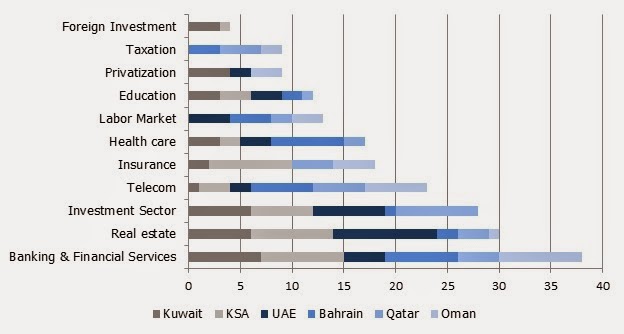
In the context of the aforementioned characteristics or essential features of regulations, it is worth mapping the framework to the GCC environment. The below chart illustrates the number of reforms, sector wise in the GCC, since 2008. It is interesting to note that foreign investment is an area where there have been only subdued regulatory movements; while Banking and Financial Services has witnessed intense regulatory pronouncements. There can be reasons for this. Attracting inward foreign capital may not be an immediate priority for liquidity rich GCC states. However, FDI is just not about attracting capital, only. Foreign investment can also enhance the talent pool in the region, bring new technologies, and above all, improve investor confidence and upgrade global perception. On the contrary, Banking and Financial Services is a dominant and highly mature sector contributing to over 50% of the market capitalization in the respective stock markets of the GCC countries. In the absence of an active debt market and due to a paucity of long-term funding instruments, banks end up being the primary mover of the financial wheel. This explains the “over regulated” nature of this sector.


Indicative Number of Reforms in GCC (2008-2013)
Source: Markaz Research

So, what then makes regulations effective?

1.     Balance: Under regulation may inhibit the growth of a sector; while excessive regulations may increase the cost of doing business. Hence, the need to balance regulations carefully.

      2.     Oversight: Declaring a regulation is only the opening gambit, while the real challenge lies in the implementation on the ground. A case in point are the Capital Market Authorities across many GCC countries. While CMAs’ require a spate of documentation to be submitted by the companies, they may not have the commensurate infrastructure or technology to monitor all the submissions and take action where necessary.

      3.     KPI's: Regulations become effective only when regulators don’t limit their role to just policing and fining. The agenda of regulators should be more broad based and should include the development and growth of the sectors that they are regulating. If after a decade of regulations, a sector has failed to demonstrate growth and development, then the regulators should also share the blame!

      4.     Cost: Mindless regulations should be avoided as compliance cost is an important component with respect to economic efficiency. This is particularly true of “imported regulations”, which under the name of best practices, are whisked in with little consideration given to their applicability vis-à-vis local realities.


In summary, it can be said that there can be no doubt about the integral and important role that effective regulations have. The role that they play in the organized development of a market cannot be understated or deemphasized. However, calibrating regulations and achieving a fit balance is the need of the hour.

February 17, 2013

Professionalism more important than regulations

This article was originally published in Arab Times


The financial reforms that are in full swing around the world will remain incomplete and ineffective if they do not also fundamentally improve the behavioural norms of those working in finance and investments. Yet, the signs are that an unbalanced emphasis on new regulations and industry structures risks neglecting the equally important need to improve the values and conduct of practitioners. Nitin Mehta from CFA Institute and Raghu Mandagolathur from CFA Society Kuwait discuss the need for behavioural change for finance and investment professionals.


Happily, the template for a solution already exists: professions have long regulated their members' behaviour for the ultimate benefit of society. Of course, it was not always so. In earlier times, there were no restrictions to practise as a doctor, lawyer or an accountant. But frequent experiences of malpractice led to an inevitable realisation that controls were required to establish standards of practise in order to protect the public.

Today, most of us would not consult a doctor for our health unless she was properly certified, current in her expertise, and followed an ethical code. Yet, many readily entrust their savings to those who do not have these qualifications. After the recent crisis, it seems high time that what we expect from healthcare is also demanded from 'wealthcare'. Greater professionalisation of workers in finance should be sought as a remedy which complements new regulations.

Society  rightly demands  more  from  a  profession  and  its members  than  it  does  from  a  trade and its craftsmen.  In return for status, self-regulated autonomy, and often rich rewards, a profession extends a public warranty that it has established conditions of entry, standards of fair practice, disciplinary procedures and continuing education for its members. In doing so, the profession improves the quality of its practitioners for the benefit of their clients. While the most conscientious employers and practitioners join professional associations and adopt their standards, many more do not. A lack of consistent regulation is usually the cause of such a state of affairs.

The GCC region is initiating major regulatory reforms as a swift response to the financial crisis and its aftermath. Celebrated cases of corporate failures, restructurings, defaults and other impediments are sought to be remedied through establishment of new regulatory structures (like ESCA in UAE or the Capital Markets Authority (CMA) in Kuwait) or through new strictures. However, this is not an assurance to prevent recurrence of similar problems or emergence of new problems. The money management industry in the GCC should progress on professionalism as much as it progresses on regulatory reforms. Recruitments to key positions involving financial advice both at institutional and retail level sill happen based on networking skills and language proficiency rather than professional skills as measured by relevant global qualifications combined with multi-disciplinary experience. As the region goes through the next phase of massive government expenditure, it is imperative that regulatory progress is accompanied by a realization of the need to professionalize the workforce especially at a decision making level.
 

The recent crisis revealed how serious flaws had developed in the culture of finance. Over recent decades, secular shifts in values resulted in too much emphasis on profits and not enough on professionalism;  an excessive celebration of innovation and entrepreneurship, and not enough of ethics; an unhealthy focus on building a career, instead of character and competence. In other words, a swing in favour of business success and away from professional values. If this arc is not reversed and trust restored, there may not be much of a business left.

Much needs to be done urgently. Regulators should drive broader professionalisation of the financial sector; greater emphasis on professionalism must properly complement and balance the regulatory and industry overhaul reshaping finance. At the same time, employers should require their most valued employees to actively seek professional status as a condition of employment; long-term competitive advantages and investor confidence could be built in this way.  And individual practitioners should adopt the higher standards and obligations of a profession, transforming their work into a vocational calling. Nothing less than such co-ordinated action will reshape the future of finance and protect the laity. 

May 01, 2010

Reasons to be cheerful about new GIPS standards


This article was originally published in Arab Times

The recently released Global Investment Performance Standards (GIPS®) outline new standards for presenting investment performance to potential investors.  Mr. Raghu Mandagolathur, President of CFA Kuwait, discusses these standards and why an investment firm would want to implement them.

The asset management industry in the GCC is rapidly evolving.  It is currently home to more than 325 mutual funds with nearly $ 125 billion under management including managed accounts.  Kuwait has established itself as a key hub within the region, and is currently home to around 65 funds (or 20% of the total) with an estimated assets under management of $58 billion.  Kuwait also boasts the oldest stock exchange in the region, probably the third largest in terms of market capitalization. Consequently Kuwait continues to develop a vibrant and growing domestic and international investment community with the presence of nearly 100 investment companies.  

If Kuwait is to continue to attract the very best investors from both home and abroad, to evolve and grow its investment industry, we must promote high standards of performance measurement and presentation, to help promote better transparency, market integrity and fairness. The importance of setting standards in performance reporting has become paramount.   

But what standards should we use and how should they be introduced?  At CFA Kuwait we believe GIPS® provide a suitable framework to help raise standards of investment management in Kuwait and around the GCC.


What are the Global Investment Performance Standards (GIPS®)?

GIPS are voluntary ethical standards for the calculation and presentation of investment performance.  Their genesis dates back to the 1980s when unscrupulous investment managers presented their best-performing portfolios to prospective clients in hopes of winning their business. 

This performance was generally not representative of the firm’s overall investment results for that strategy.  The focus of the GIPS standards, therefore, is the presentation of performance to prospective clients who want reliable performance metrics based on the principles of fair representation and full disclosure. 

 
What areas do the GIPS standards cover?

The GIPS standards address such topics as input data, calculation methodologies, composite construction, performance presentation, and disclosures in both traditional and alternative asset classes.  The Standards are continually evolving to meet the needs of a dynamic industry.  Interpretations are developed and issued on an ongoing basis to assist firms in implementing and applying the Standards.
 

What is a composite?

A composite is an aggregation of portfolios managed in accordance with similar investment mandates, objectives, or strategies. All discretionary fee-paying portfolios must be included in at least one composite, and composite performance must be calculated and presented as the asset-weighted average of the performance of the portfolios within the composite.  Investors are thus presented with performance that is truly representative of a firm’s investment results for a particular strategy.

 
Do the standards apply to public equity funds and private equity funds in the same way?

Many provisions of the GIPS standards apply to both public and private equity investments.  However, the GIPS standards also include specific requirements and recommendations for private equity (as well as real estate).  Most private equity investments are made through limited partnerships in which the investment manager controls the timing of capital drawdowns and distributions.  The GIPS standards require the use of a different calculation methodology, the internal rate of return, that reflects the timing of those cash flows.

 
What is new in the 2010 edition of the GIPS standards?

The recently released 2010 edition of the GIPS standards introduces several important new concepts.  Firms will be required to value investments based on fair value rather than market value.  Although fair value and market value are often the same for liquid securities, liquidity may dry up at times and market values may not be available or reflective of the true value of the investment.  For investors, it is essential to know what their investments are actually worth. 

New provisions have also been added to address risk, including a requirement for firms to present the three-year standard deviation of composite and benchmark returns.  This is not the most sophisticated nor, for some strategies, the most appropriate measure, but it establishes a foundation for comparability.  The decision to include provisions related to risk is a clear statement that performance includes both risk and return and investors must evaluate both.

 
Do the GIPS standards prevent fraud?

Although the GIPS standards are not specifically designed to prevent fraud, the Standards require firms to present only the performance of actual assets under management and not hypothetical or model performance.  In addition to requiring firms to adhere to all applicable laws and regulations, the Standards prohibit the presentation of any performance information that is false and misleading.  The comprehensive policies and procedures required by the GIPS standards give investors additional comfort regarding a firm’s infrastructure and operational controls.


How do firms demonstrate compliance?

Firms can claim compliance once they have met all the requirements of the Standards and prepare a compliant performance presentation.  Firms can also have an independent verifier assess if the firm has complied with the composite construction requirements of the GIPS standards and if the firm’s policies and procedures are designed to calculate and present performance in compliance with the Standards.
 

Why should investment firms implement the GIPS standards?

Compliance with the GIPS standards signals to the marketplace that a firm is committed to integrity and enhances a firm’s credibility when competing for assets.  Because the GIPS standards are global, compliance provides firms with a passport to compete with other firms worldwide. In addition, firms that implement the Standards may strengthen internal controls and increase the consistency of their performance data.


An earlier version of this article appeared in the international edition of the Financial Times (FTfm supplement).  In addition to Mr. Mandagolathur’s comments,  Mr. Jonathan Boersma, executive director of the Global Investment Performance Standards at CFA Institute and Mr. Philip Lawton, CFA, CIPM, head of the CIPM program, also both contributed to this article.